
Form and variety
Paddy, brown, white, parboiled, broken, long/medium/short grain or aromatic identity.
Rice reviewed by processing state, broken percentage and milling degree.
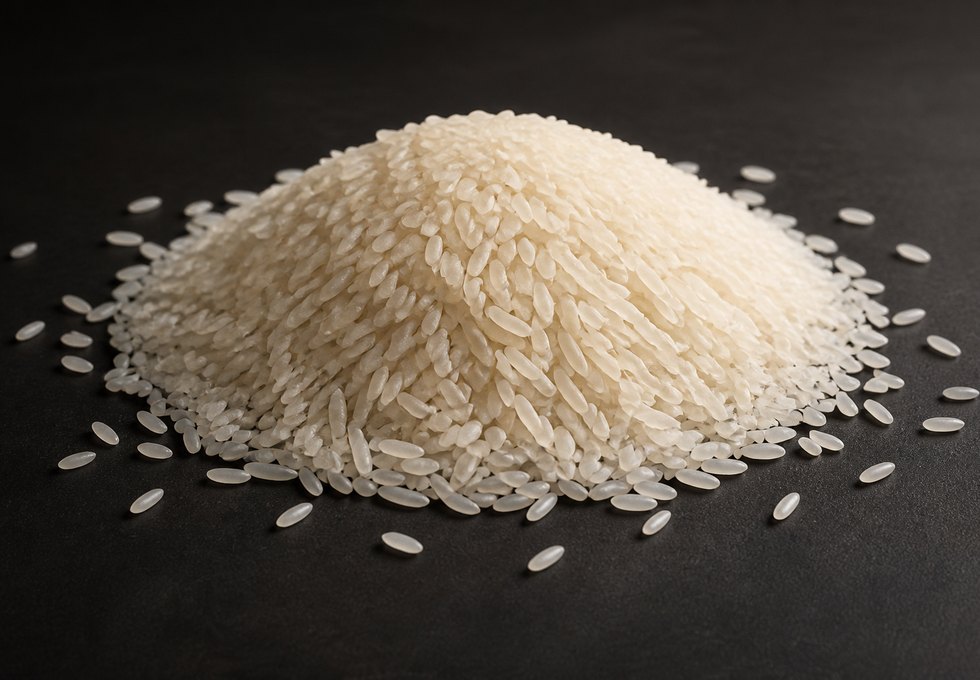
Paddy rice, brown or cargo rice, milled white rice, parboiled rice, aromatic rice and broken rice are not equivalent. The commercial form defines yield, packing, certification and buyer expectation.
Broken percentage, moisture, milling degree, chalkiness, damaged or discoloured kernels and varietal identity may matter more than a generic rice description.
Rice has its own process: drying, husking, separation, milling, polishing and grading determine the final product.
Reduce moisture to protect grain before storage or milling.
Remove the husk to obtain brown or cargo rice where applicable.
Separate remaining paddy, whole kernels, broken kernels and foreign material.
Produce white or polished rice according to specification and milling degree.
Define broken %, variety, weight, packing and dispatch.
Broken percentage is a central trade reference: 5% broken rice does not compete with 25% broken rice or broken rice intended for processing.
Varietal identity and grain length matter in long, medium/short or aromatic rice. Parboiled rice includes soaking, steaming and drying before milling.
Residue, mycotoxin or contaminant limits depend on destination and food use and should be stated by contract and certificate.
Rice can deteriorate through moisture, insects, odour, discolouration, varietal mixing and additional breakage during handling. Packing and storage history are part of quality.
In B2B transactions, the certificate should connect lot, variety, type, broken %, moisture, milling degree, origin and packing. Without that link, commercial traceability is incomplete.
KaizenGTC facilitates document review and commercial coordination; it does not operate rice mills or certify origin.
| Element | Verification |
|---|---|
| Paddy | Rice with husk; requires drying and further milling. |
| Brown / cargo | Husked grain with bran layer; not the same as polished white rice. |
| White / milled | Milled product with defined polishing and broken percentage. |
| Parboiled | Hydrothermal treatment before milling; must be declared as a specific process. |
| Broken rice | Own commercial form for certain uses; should not be hidden as whole rice. |
USDA PSD 2025/26 reports rice on a milled-equivalent basis. Large producers and consumers should be separated from exporters and importers.
| Market | Role | Context / period |
|---|---|---|
| China, India and Southeast Asia | PRODUCTION / CONSUMPTION | Production and food-consumption context; not read by export role alone. |
| India, Thailand, Vietnam and Pakistan | EXPORT | Relevant origins in trade, subject to policy and crop year. |
| West Africa, Middle East and importing Asia | IMPORT | Markets where broken %, variety and price can decide purchase. |
Sources: USDA FAS Production, Supply and Distribution · IRRI Rice Knowledge Bank · FAOSTAT crops and livestock products · Codex Alimentarius food standards
Paddy, brown, white, parboiled, broken, long/medium/short grain or aromatic identity.
Broken %, moisture, milling degree, chalkiness, damaged or discoloured kernels and foreign matter.
Phytosanitary certificate, origin, fumigation where applicable, packing list, weight and lot-linked certificates.
It states the proportion of broken kernels and changes value, use and commercial comparison.
Paddy still has the husk; milled white rice has been husked, milled and usually polished.
Paddy is soaked, steamed and dried before husking and milling, according to the industrial process.
No. It should support varietal identity, origin, aroma and its own specification where required by the buyer.
Food rice may move in bags or containers with requirements for moisture, odour, pests and breakage control.